200-Hour Trauma-Informed Yoga Teacher Training

Established 2026

View program website

In person

Mar 1 – Mar 22, 2027

22 days • 200 hours • $ 3400+

Santiago Atitlán, Sololá, GT

Carrie Hoffman

Led by

Carrie Hoffman

Level 2 Yoga Teacher Badge CYT-L2
Inquire

See up-front pricing

Purpose

Why is Trauma-Informed Yoga included in a 200-Hour YTT?

Because you never know who’s walking into the room.

All yoga teachers need trauma-informed training because every yoga class holds a room full of histories. Trauma doesn’t announce itself obviously. It sometimes shows up in a tight hip, a held breath, a student who can’t close their eyes. The Bigger Life YTT prepares you to meet all of it: with skill, with steadiness, and with a practice that goes far deeper than posture cues. You’ll complete training with a deeper understanding of your own practice. Our goal is to prepare aspiring yoga teachers to be of service to the many needs of this world, wherever they end up teaching.

Who this 200-Hour Yoga Teacher Training in Guatemala is right for…

This training was built for YOU! Wherever you are on your path, we have space for you.

What to expect

You won’t just be certified on paper. You’ll actually be ready.

A complete yoga teacher training with a trauma-informed foundation:

In addition to a full module on trauma-informed facilitation, this vital methodology we strongly believe in will be woven into every class. You’ll understand how to create safety and accessibility for any body in any room, whether the class  you’re teaching is labeled “Power Vinyasa” or “Trauma-Sensitive Yoga.” Click on

Confidence to teach flow with wisdom and intention:

Deep immersion in vinyasa and hatha sequencing, alignment, teaching creativity, assists, and the art of teaching, starting from day one. We’ll journey through the energetic anatomy of the seven chakras together in daily guided practices and class breakdowns that incorporate much more than just movement.

A living yoga philosophy:

Yoga history, the Yoga Sutras of Patanjali, the 8 Limbs of Yoga, Ayurveda, and more, not as theory to memorize, but as practices to embody, discuss, and share. Through lectures, discussions, and practice teaching, you’ll come away with retained knowledge on the whole of what yoga is. Hint: it’s so much more than just what you do on your yoga mat!

The ability to teach anywhere:

Studios, retreats, treatment facilities, schools, detention centers, corporate settings. You’ll have the tools to adapt your teaching to any context.

A community for life:

12-17 people. 21 days at Mystical Yoga Farm. Off-grid, fully present. The bonds formed in containers like this don’t fade. You’ll form lasting friendships that become your professional and personal foundation. The Bigger Life YTT includes post-training online integration circles and a 1-on-1 mentorship session follow up with a trainer.

A globally recognized 200-hour yoga credential, backed by Bigger Life Adventures’ lineage of trauma-informed teaching.

Style/Lineage

Trauma-informed facilitation styles combined with hatha/vinyasa teaching and sequencing.

Lineage - Vinyasa via Quantum Yoga and Lakshmi Rising

Trauma-informed via Prison Yoga Project

Philosophy, ritual, and Ayurveda via Dr. Robert Svoboda, the Nath lineage, Forest Path

Additional Information

Core competencies

By the end of this program, graduates will be able to…

Anatomy, Physiology, Biomechanics
  • Identify the regions, natural curves, and movements of the spine by naming each region and matching the six movements of the spine to the asana families that create them.
  • Describe the major body systems and muscle groups used in asana by explaining which muscles move or stabilize the major joints in key poses from each asana family.
  • Explain the anatomy and physiology of the respiratory system and the diaphragm by describing how different pranayama techniques shift the nervous system toward activation or relaxation.
  • Explain the neuroscience of trauma and the stress response by describing the roles of the brain, vagus nerve, and sympathetic and parasympathetic nervous systems in fight, flight, freeze, and regulation.
  • Discuss the physical and mental effects of yoga by connecting specific asana, pranayama, and meditation practices to their effects on the musculoskeletal, nervous, and respiratory systems.
  • Apply anatomical contraindications and human variation to asana by offering props, modifications, and variations that respond to individual bodies, injuries, and limitations.
  • Identify the limits of a yoga teacher's scope of practice by recognizing when a student's needs call for referral to a medical or mental health professional and avoiding any diagnosis or treatment claims.
Business Skills
  • Describe yoga alliance registration, standards, and continuing education by explaining the steps to register as an ryt 200 and the code of conduct and scope of practice they agree to.
  • Develop a personal yoga vision by defining who they want to serve, in what settings, and setting achievable goals for their first year of teaching.
  • Create a values-aligned personal brand by drafting a brand statement, offering description, and teacher bio that reflect their authentic voice.
  • Write a 1,000-word essay describing how they plan to use what they learned in yoga teacher training in their life and work.
  • Describe how to build a sustainable and ethical yoga career by identifying ways to price, market, and offer accessible classes that stay true to yogic ethics.
Lifestyle & Ethics
  • Apply the yamas and niyamas by reflecting in writing and group discussion on how each guides personal choices and teaching relationships.
  • Describe foundational ayurveda, including the doshas, gunas, and daily and seasonal rhythms by identifying their own dominant dosha and choosing a balancing daily practice.
  • Explain yoga's sister sciences, jyotish and vastu by summarizing their core principles and their relationship to ayurveda and yoga.
  • Discuss ethical teacher and student relationships by identifying power dynamics, consent, and boundaries according to the yoga alliance code of conduct.
  • Apply sober and mindful living by maintaining an alcohol- and substance-free lifestyle throughout the training and reflecting on personal coping patterns.
  • Apply karma yoga through seva by fulfilling karma yogi duties, including creating and explaining an altar, guiding a gratitude ritual before a meal, and caring for shared spaces.
  • Discuss living yoga off the mat, including sustainability and environmental ethics by connecting principles such as ahimsa and aparigraha to daily choices and to life on an off-grid, low-waste farm.
Yoga History & Theory
  • Describe the history of yoga and its key texts, including the vedas, upanishads, yoga sutras, bhagavad gita, and hatha yoga pradipika by placing each in its historical period and summarizing its core contributions.
  • Explain the eight limbs of patanjali's yoga sutras by defining each limb and giving a practical example of how it applies on and off the mat.
  • Discuss samkhya philosophy, samskaras, and the kleshas by explaining how these teachings describe the causes of suffering and the path toward freedom.
  • Discuss the teachings of the bhagavad gita and karma by reflecting on its paths of yoga and relating them to their own lives.
  • Compare major yoga lineages and tantra by contrasting the origins, methods, and emphasis of traditional and modern styles.
  • Describe the subtle body, including the koshas, nadis, chakras, granthis, vayus, and bandhas by locating each and explaining its role in yoga practice.
  • Discuss the role of hinduism in yoga, cultural appropriation, and yoga as social justice by identifying respectful ways to honor yoga's roots in their own teaching.
  • Teach a philosophical theme by weaving a concept from yogic texts into a class introduction, cues, and closing.
Practice Skills
  • Practice daily asana in hatha, vinyasa, yin, and restorative styles by participating in daily sadhana throughout the training, including the online pre-training chakra series.
  • Demonstrate pranayama techniques including sama and visama vritti, ujjayi, nadi shodhana, surya and chandra bhedana, kapalabhati, bhastrika, sitali, bhramari, and simhasana using correct posture, breath counts, and pacing, and stating key contraindications.
  • Practice a range of meditation techniques, including mindfulness, body scan, vipassana, metta, japa, trataka, and sound meditation by keeping a consistent personal practice and journaling about their experience.
  • Practice yoga nidra by completing guided yoga nidra practices and noting changes in body, breath, and mind before and after.
  • Perform traditional mantras and chants, including om, asato ma, so hum, lokah samasta, and the hanuman chalisa with respectful pronunciation and an understanding of their meaning, and by writing a personal mantra.
  • Demonstrate the bandhas (mula, uddiyana, jalandhara) by engaging each in practice and describing where they feel it in the body.
  • Demonstrate sun salutations and foundational postures from each asana family with safe alignment and appropriate use of props.
Teaching Skills
  • Plan a 60-minute themed yoga class that includes a self introduction and class style, a philosophical theme, centering or meditation, pranayama, warm ups, at least two sun salutations, a flow leading to a peak pose, counterposes, and a closing.
  • Create a peak pose sequence by using the sequencing chart to prepare the component parts of the peak pose and choosing appropriate counterposes.
  • Cue alignment, breath, and transitions using clear, concise, invitational language and effective vocal dynamics.
  • Teach a 60-minute class to peers as a final teaching assessment during the last week of training, and integrate feedback from lead trainers and peers.
  • Modify postures for different bodies, abilities, and experience levels by offering props, variations, and options for every pose taught.
  • Assess when and how to offer hands-on adjustments by asking for consent every time, offering easy ways to opt out, and favoring verbal cues first.
  • Lead pranayama and meditation practices with accurate counts, good pacing, and clear adaptations and contraindications.
  • Guide a yoga nidra or guided relaxation using a calm, steady voice and language that preserves student choice.
  • Assess the needs of students in a group class by observing alignment, breath, and signs of nervous system dysregulation and adjusting the class in real time.
Other
  • Explain trauma and its forms, including acute, complex, and intergenerational trauma and adverse childhood experiences (aces) by describing how social location affects the likelihood of trauma.
  • Explain resilience, co-regulation, and neuroplasticity by describing how safe relationships and repeated practice help the nervous system build capacity.
  • Recognize common symptoms of trauma and cues of safety by identifying how trauma may show up in a yoga class and the teacher behaviors that help students feel safe.
  • Facilitate a trauma-informed yoga class using invitational language, choice, predictable structure, grounding, and interoceptive check-ins.
  • Create community agreements that support safety, consent, and inclusion in a trauma-informed teaching setting.
  • Adapt trauma-informed practices for at-hope communities such as youth in detention, people in recovery, and school settings, by tailoring language, structure, and pacing to the group.

AYC allows each school to state and evaluate the competencies each student acquires. Students rate how well the program delivered them.

Program Emphasis

Evaluation methods

Program evaluations
  • Graded Demonstration
  • Oral Exam
  • Written Exam
  • Written Submission
  • Solo Project Or Presentation
  • Group Project Or Presentation
  • Other
  • Direct Observation
  • Graded Skill Demonstration

Our evaluation is ongoing, supportive, and trauma-informed. We want every trainee to leave confident and ready to teach, so assessment happens throughout the training rather than in one high-pressure moment.

To graduate, trainees complete all 200 hours with 100% attendance, including 20 hours of online pre-training with written reflection assignments that we review before we gather in person. Trainees also write a 1,000-word essay on how they will carry what they learned into their life and work.

The heart of the evaluation is a 60-minute teaching practicum taught to peers during the final week. Each class must include an introduction, a philosophical theme, centering or meditation, pranayama, warm ups, Sun Salutations, an intelligent flow to a peak pose, counterposes, and a closing. Lead trainers score it with a written rubric covering sequencing, cueing, safety, modifications, consent, and trauma-informed facilitation, and every trainee receives written and verbal feedback.

Knowledge of anatomy, philosophy, Ayurveda, and ethics is checked through short quizzes, oral questions in class, small-group presentations, and written assignments. Personal practice, pranayama, meditation, and karma yoga duties are assessed through direct observation by lead trainers. Any trainee who needs more time or support receives one-on-one mentoring and the chance to retake a quiz or reteach before certification.

Did you graduate from this program?

Program Faculty

Featured Faculty

Carrie Hoffman
Carrie Hoffman
Level 2 Yoga Teacher Badge
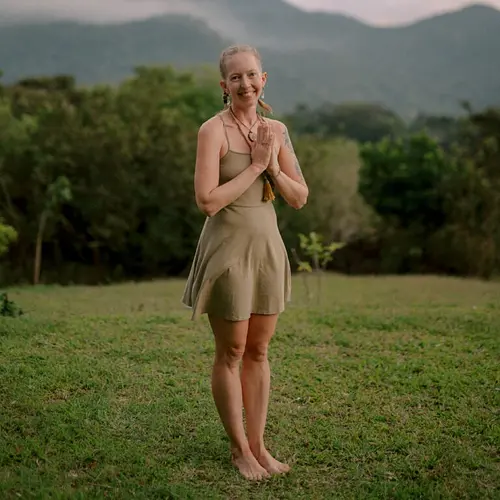
Carrie Hoffman has practiced yoga for 14 years and taught for 8. She teaches trauma-informed, recovery-aware classes on retreats, in treatment facilities, schools, and institutions.
Williams, AZ, US

Policies

View program website
AYC Cookies 🍪
We use cookies to optimize your web experience. We do NOT sell your data or use it for ads.
Manage preferences